Horizon Distance
The horizon distance, denoted \(D_{\rm hor}\), is a key metric for assessing the sensitivity of a gravitational-wave detector or network. It is defined as the maximum luminosity distance at which a specific GW source can be reliably detected, i.e., where its signal-to-noise ratio (SNR) meets or exceeds a given threshold, typically \(\rho_{\rm th} = 8\).
This distance is computed under the optimal scenario: the source is directly overhead and face-on with respect to the detector(s), providing the strongest possible signal. The gwsnr package offers two approaches for calculating the horizon distance: an analytical scaling method and a numerical root-finding method.
1. Analytical Method
The analytical approach calculates the horizon distance by scaling a known SNR measurement. For any generic inspiral–merger–ringdown (IMR) waveform, the horizon distance can be determined from the optimal SNR (\(\rho_{\rm opt}\)) at a given effective distance (\(D_{\rm eff}\)):
Notably, this approach does not require explicit optimization over sky location, as the dependence cancels between the SNR and the effective distance.
In gwsnr, \(\rho_{\rm opt}\) is computed using the core functionalities, such as the noise-weighted inner product or the Partial Scaling interpolation method. The package also includes a JIT-compiled function for efficient evaluation of \(D_{\rm eff}\).
This general formula in Eq.(1) is rooted in the work of Allen et al. (2012), which provides a specific analytical expression for simple inspiral waveforms:
where \(\mathcal{M}\) is the chirp mass, and \(\mathcal{A}_{1~\mathrm{Mpc}}\) denotes the waveform’s intrinsic amplitude at a distance of 1 Mpc. While Eq.(1) was originally derived for simple inspiral signals, it remains applicable to general IMR waveforms dominated by the quadrupolar (2,2)-mode, provided an appropriate waveform model is used to compute \(\rho_{\rm opt}\).
2. Numerical Method
The numerical method directly determines the horizon distance by finding the specific distance at which the SNR matches the detection threshold. This involves two main steps:
Optimization: For a given set of relevant GW parameters (masses, spins, phase, etc.),
gwsnrfirst finds the optimal sky location (for each detector) that maximize the SNR, providing the best-case SNR for that source type at a reference distance.Root-Finding: With the optimal configuration fixed, the algorithm then numerically solves for the luminosity distance, \(d_L\), that satisfies the equation:
\[ F(d_L) = \rho(d_L) - \rho_{\rm th} = 0 \]
This approach is also applicable to a network of detectors, in which case the optimal sky location is found for the detector network, where the single-detector SNR, \(\rho\), is replaced by the network SNR, \(\rho_{\rm net}\), and then the root-finding is performed to find the distance at which \(\rho_{\rm net} = \rho_{\rm th}\).
Example Usage
# loading GWSNR class from the gwsnr package
from gwsnr import GWSNR

# initializing the GWSNR class with default configuration and interpolation method
gwsnr = GWSNR(mtot_min=2., mtot_max=6., ifos=['H1', 'L1', 'V1'])

# 1. Analytical Method
d_hor_analytical = gwsnr.horizon_distance_analytical(mass_1=1.4, mass_2=1.4)

# 2. Numerical Method
d_hor_numerical, _, _ = gwsnr.horizon_distance_numerical(mass_1=1.4, mass_2=1.4)

# print the type of the SNRs
print(f"horizon distance (analytical): {d_hor_analytical} Mpc")
print(f"horizon distance (numerical): {d_hor_numerical} Mpc")
horizon distance (analytical): {'horizon_distance_L1': array([416.49490771]), 'horizon_distance_H1': array([416.49490771]), 'horizon_distance_V1': array([317.93916075])} Mpc
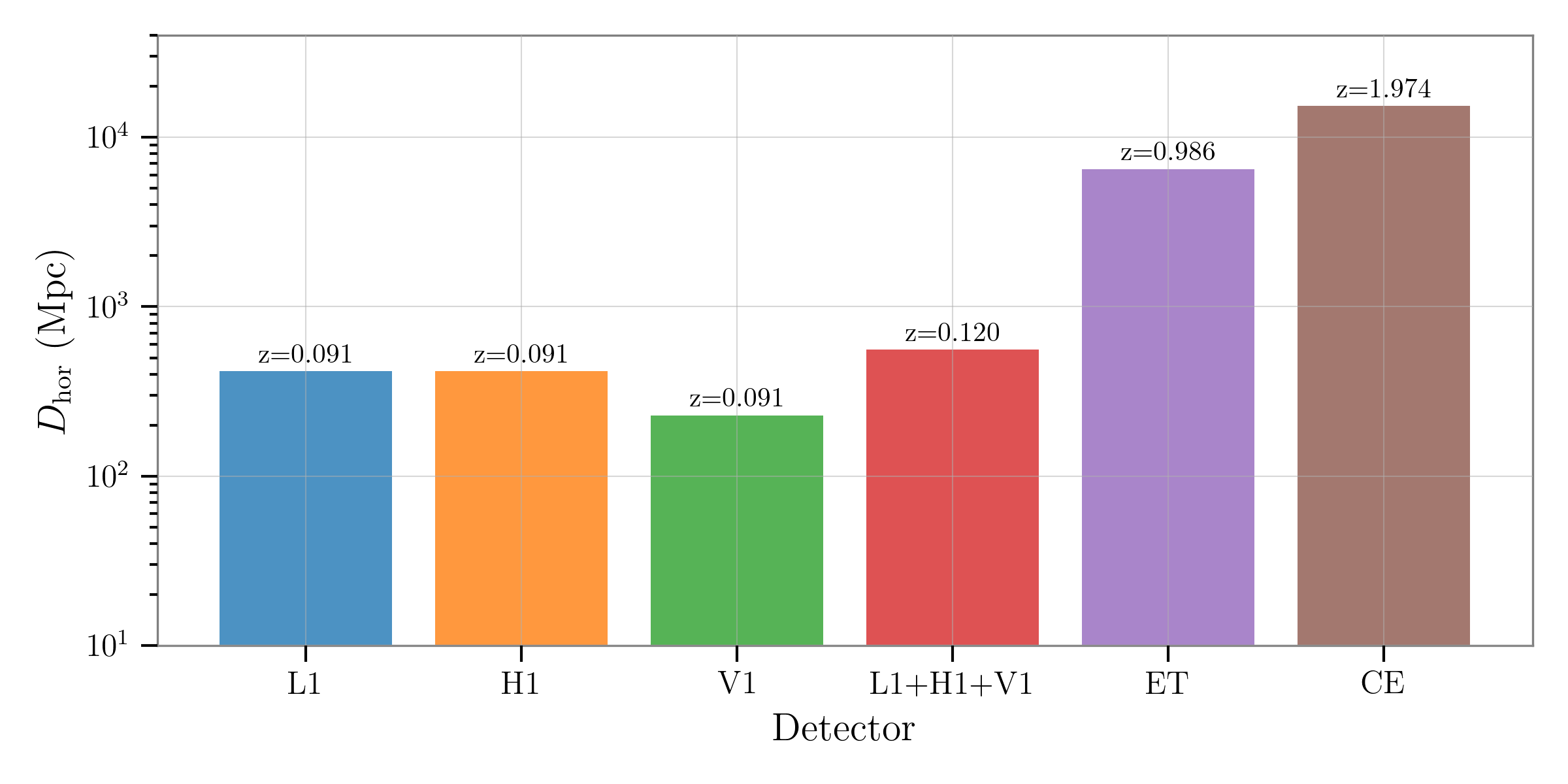
horizon distance (numerical): {'horizon_distance_L1': 416.49483499582857, 'horizon_distance_H1': 416.4948722301051, 'horizon_distance_V1': 228.76581222284585, 'horizon_distance_net': 557.9508489044383} Mpc
Horizon Distance of a BNS System across various Detectors