Summary
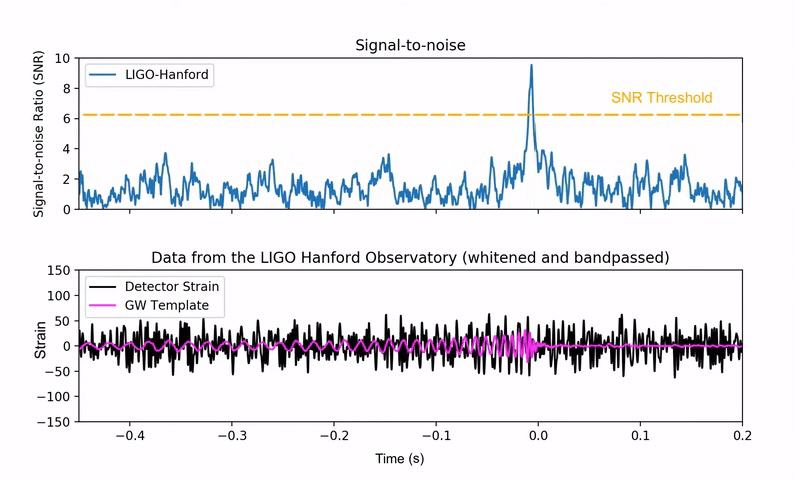
gwsnr is a Python package for efficient and accurate computation of the optimal signal-to-noise ratio (\(\rho_{\rm opt}\)) and probability of detection (\(P_{\rm det}\)) in gravitational-wave (GW) astrophysics. It is designed for large-scale simulations of compact binary mergers (BBH, BNS, and BH-NS systems) and for hierarchical Bayesian inference studies that require repeated SNR or \(P_{\rm det}\) evaluations under selection effects.
In population simulations and rate-estimation workflows, \(P_{\rm det}\) must be evaluated many times. Standard noise-weighted inner products are accurate but become a bottleneck at scale. Packages such as Bilby, PyCBC, and GstLAL are not primarily built for millions of fast detectability checks. gwsnr fills that gap: it provides a modular detectability engine with user-controlled detector, waveform, and population settings, and can model both \(\rho_{\rm opt}\) and the noise-realised matched-filter SNR (\(\rho_{\rm obs}\)) under stationary Gaussian noise assumptions.
To gain speed, gwsnr combines NumPy vectorisation, JIT compilation via Numba, optional JAX and MLX backends, and Python multiprocessing. The partial-scaling interpolation path achieves accuracy above 99.5% compared with standard inner-product calculations and speed-ups of order \(5{,}000\times\) relative to Bilby in benchmark tests (see performance summary). The package is used as the core detectability calculator in ler.
Key capabilities
Noise-weighted inner product:
Accurate SNR computation for arbitrary frequency-domain waveforms, including precessing and higher-order harmonic models fromLALSuite. Accelerated with multiprocessing and JIT-compiled routines; optionalJAXbackend viaripplegw.Partial-scaling interpolation:
Fast method for non-spinning and aligned-spin binaries. Precomputes partial-scaled SNRs on parameter grids and recovers \(\rho_{\rm opt}\) by simple rescaling.ANN-based \(P_{\rm det}\) estimation:
OptionalTensorFlow/scikit-learnmodel for settings where direct interpolation is impractical. Users can retrain models for different detectors or populations.Hybrid SNR recalculation:
Uses interpolation or ANN estimates first, then re-evaluates events near the detection threshold with the exact inner-product method.Statistical \(P_{\rm det}\) models:
Gaussian and non-central \(\chi^2\) models for \(\rho_{\rm obs}\) in single- and multi-detector networks. Supports user-defined thresholds and catalogue-based sensitivity functions.Horizon distance (\(D_{\rm hor}\)):
Maximum distance at which a source is detectable above a given \(\rho_{\rm opt,th}\), via analytical rescaling or numerical root-finding.Modular API:
Flexible combination of waveform models, detector noise PSDs, and configuration parameters for population synthesis, rate estimation, and hierarchical inference with selection effects.
Applications
gwsnr supports GW population statistics, astrophysical rate estimation, detector-sensitivity studies, and selection-effect modeling in hierarchical inference. It is integrated into ler for simulating detectable unlensed and strongly lensed events.
For the full technical description, see the gwsnr paper. Mathematical and implementation details are in Inner Product, Interpolation, ANN, Hybrid, Probability of Detection, and Horizon Distance.